

By Anne-Marie Fowler, Managing Director, Priory Law
On 19 June 2026, the government published its long-awaited roadmap for home buying and selling reform. It is the most significant formal commitment to reforming the conveyancing process in a generation.
I have read it in full. I want to explain what it says, what it means for buyers and sellers right now, and what it means for firms like ours that have already been working this way.
What the government has announced
The reform roadmap sets out a phased programme of change built around five goals: faster transactions, fewer fall-throughs, higher professional standards, better-informed consumers, and a property market people can trust.
The headline measures are:
- Upfront property information packs. Sellers and estate agents will be required to provide comprehensive information at the point of listing - covering the property's condition, leasehold details, chain status and more. The aim is that issues surface before an offer is made, not months later.
- Binding conditional contracts. Transactions will become legally binding much earlier, at the point an offer is accepted. Parties will face a financial penalty for withdrawing without valid reason. This directly targets the fall-through problem, which currently costs consumers around £400 million a year.
- Digital property logbooks and packs. A single, trusted digital record for each property, accessible to all parties throughout the transaction. Less duplication, less chasing, less waiting.
- AI-enabled conveyancing. The government has established an AI Growth Lab focused initially on legal services and conveyancing. Applications from conveyancing firms opened in summer 2026.
- Regulation of property agents. A Code of Practice setting minimum standards, and a pathway to mandatory qualifications for estate and letting agents.
The changes will be introduced in phases. Some begin now. Legislation for the full requirements - including mandatory sales packs and binding contracts - will follow when parliamentary time allows.
Why this matters
The numbers in the roadmap are striking. Around one in three transactions currently fall through. The average time from offer to completion has grown to approximately 120 days - around 60% longer than it was in 2007. Fall-throughs alone cost the economy an estimated £1.5 billion a year.
These are not abstract statistics. They are the experience of real people who planned a move, paid for surveys and searches, told their children they were changing schools, handed in notice to a landlord - and then watched it fall apart at the last moment because information that should have been available at the start only surfaced after months of effort.
The government's analysis is the same as ours: the fundamental problem is that the wrong information arrives at the wrong time. Issues surface late, when delays are costly and fall-throughs are likely. The solution is to move that information to the front of the process
What this means for buyers and sellers right now
The mandatory requirements are not in place yet. But the direction is clear and the pace is deliberate.
If you are buying or selling a home in the next year or two, the process will not look dramatically different in the immediate term. What will change, gradually, is the quality of information available to you at the outset, and the willingness of all parties to commit earlier.
What this means in practice with the new home buying and selling reform
- Estate agents should be providing more detailed and accurate information about properties in their listings. This is being formalised now, before legislation.
- Voluntary sales packs are being encouraged in the interim. Sellers who choose to prepare key information upfront will be better positioned when mandatory requirements follow.
- Choosing a conveyancing firm that already works this way - with technology that identifies issues early, proactive communication, and a structured approach - matters more now, not less.
What this means for the conveyancing profession
I have spent my career believing that conveyancing should be done differently. Managed caseloads. Proactive communication. Technology that gives conveyancers better information, earlier. A personal approach that takes seriously what a property transaction actually means to the people going through it.
The government's roadmap is not telling us anything we did not already know. It is formalising it.
We wrote about this in May 2026, when the Conveyancing Task Force sent its formal briefing to Parliament. The diagnosis was the same then: excessive caseloads, inadequate supervision and weak professional standards. The government has now responded. Read: The Industry Has a Caseload Crisis. Here’s Why Priory Law Doesn’t.
For firms that have relied on volume, opacity and reactive communication, this is a significant challenge. The reforms assume that information will be shared earlier, that professionals will be accountable to defined standards, and that technology will support the process rather than patch over its weaknesses.
For firms that have already built that way, the roadmap is not a disruption. It is confirmation.
At Priory Law, we already use Orbital to analyse title documents at the earliest stage of a transaction - surfacing issues before they become delays. We already prioritise proactive communication and manageable caseloads. We already measure ourselves against what a transaction feels like for the client, not just whether it completes.
None of that happened because the government asked us to. It happened because it was the right way to work.
The government’s AI Growth Lab - now open to conveyancing firms - will set standards for exactly this kind of AI-supported early title analysis. Firms that have been working this way already will not be scrambling to catch up.
A note on liability and professional responsibility
One thing the roadmap is clear about: liability remains where it has always been. What changes is not who is responsible, but the quality and timing of the information available to support that responsibility.
For conveyancers, this is the right framing. Better information, available earlier, enables better professional judgement. It does not replace it. The reforms are designed to support the profession - not to automate it.
This is exactly why we have always been cautious about how we describe the role of technology at Priory Law. AI-powered tools are valuable because they help conveyancers do their job better. They are not a substitute for legal expertise, professional judgement or the responsibility that comes with being a qualified conveyancer.
What changes, and when
The roadmap runs in three phases. Here is what is happening at each stage.
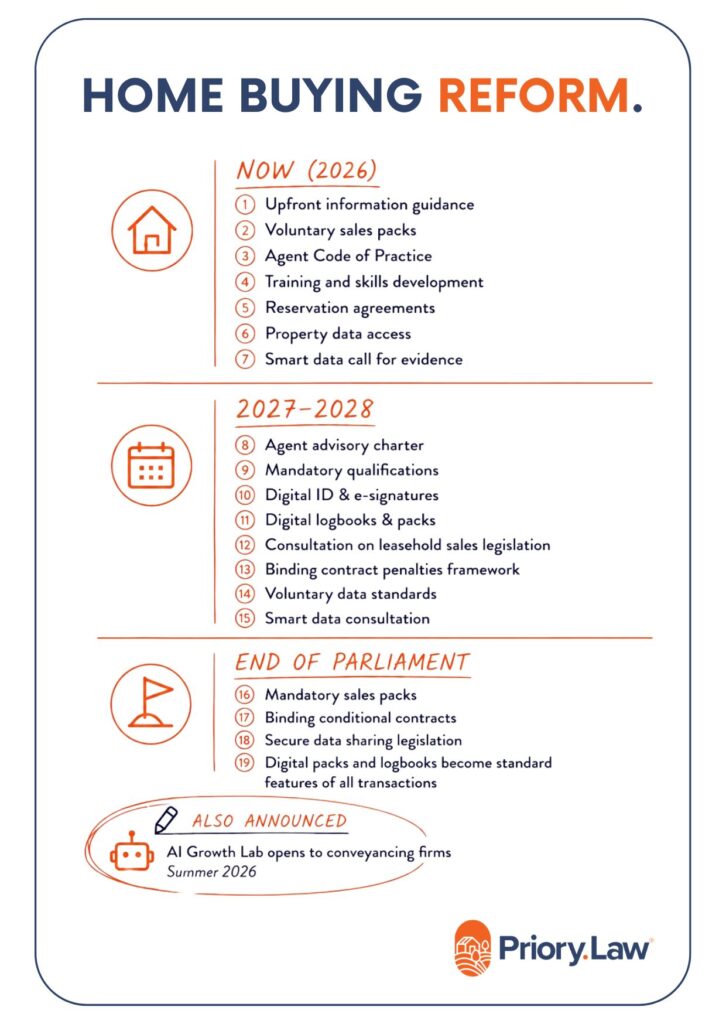
Source: Home buying and selling reform roadmap, Ministry of Housing, Communities and Local Government, 19 June 2026.
What to do if you are planning to buy or sell
The reforms make the choice of conveyancer more important, not less. Here is what to look for:
- A firm that uses technology to identify issues early - not just to send automated updates
- A conveyancer with manageable caseloads who can give your transaction the attention it deserves
- Proactive communication - before you need to ask
- Fixed, transparent fees - no surprises
- Someone who will be honest with you when problems arise, and who has the capacity to deal with them
These are not new standards. They are the standard we have held ourselves to since we opened. But the government's roadmap makes it easier to explain why they matter.
The direction is right. The work is on us.
Reform on this scale does not happen overnight. There will be a period of transition, and not everyone will adapt at the same pace. But the direction is right, and the consultation response that informed this roadmap showed clear support across the industry for the changes proposed.
For Priory Law, the roadmap is a marker in the ground. It confirms what we have always believed: that faster information, earlier commitment and better professional standards lead to better outcomes for everyone.
Conveyancing is not just a legal process. It sits at the centre of the most significant moment in most people's lives. A reform that takes that seriously deserves to be taken seriously in return.
We understand it's personal.
Frequently asked questions
What is the government's home buying and selling reform roadmap?
Published on 19 June 2026 by the Ministry of Housing, Communities and Local Government, the roadmap sets out a phased programme of reform to the home buying and selling process in England and Wales. It covers upfront information requirements, digital property packs, binding conditional contracts, AI-enabled conveyancing, and the regulation and qualification of property agents.
When will the changes come into effect?
The roadmap is phased. Some measures - including guidance on property listings and a voluntary Code of Practice for agents - begin in 2026. Legislation requiring mandatory sales packs and binding conditional contracts will follow when parliamentary time allows, with the government aiming for full implementation by the end of this Parliament.
What is a sales pack and will sellers have to prepare one?
A sales pack is a set of documents prepared by the seller at the point of listing a property, covering its condition, leasehold information, chain status and related details. The aim is that buyers have the information they need to make a confident decision before making an offer. Sellers are encouraged to prepare packs voluntarily now, ahead of a mandatory requirement being introduced through legislation.
What are binding conditional contracts?
Under the proposed reforms, a transaction would become legally binding much earlier - at the point of offer acceptance rather than exchange of contracts. Both parties would commit to clear terms and face a financial penalty for withdrawing without valid reason. This is intended to reduce fall-throughs, which currently cost consumers around £400 million a year.
Will conveyancers be replaced by AI?
No. The government’s own roadmap is explicit on this point: liability remains with qualified professionals. What changes is the quality and timing of the information available to support their work. AI-enabled tools will help conveyancers identify issues earlier and manage transactions more efficiently. They do not replace legal judgement, professional accountability or the responsibility that comes with advising someone through the most significant purchase of their life. This is the government’s position, not simply ours.
How does this affect my choice of conveyancer?
The reforms raise the bar across the industry. A well-structured firm that uses technology to surface issues early, communicates proactively and manages caseloads carefully will be better placed to deliver on the expectations the roadmap sets out. At Priory Law, this is how we have always worked.
About the author - Anne-Marie Fowler
Anne-Marie Fowler is the Managing Director of Priory Law and a qualified Licensed Conveyancer. Her career spans estate agency, lettings, block management and residential conveyancing - a breadth that gives her a fuller picture of the property transaction than most conveyancers carry. She qualified in 2015 while working full-time and raising two children. Since then she has built Priory Law around a clear conviction: that conveyancing should be done differently. Anne-Marie is a regular voice in industry conversations about AI, risk and professional standards in conveyancing.
About Priory Law
Priory Law is a specialist residential conveyancing firm acting for clients across England and Wales. Fixed fees, transparent pricing and a standard of communication we are genuinely proud of. Because every transaction is different, and every client matters. We understand it's personal.
Get in touch with Priory Law | Google Reviews | ReviewSolicitors
© Priory Law 2026. This article is for informational purposes and does not constitute legal advice. For advice specific to your property transaction, please contact Priory Law directly.