
By Anne-Marie Fowler, Managing Director, Priory Law
There is a version of this conversation happening across every profession right now. What does AI mean for the work we do? What will it change, and what should it not be allowed to change?
In conveyancing, that question is particularly loaded. Because the stakes are not abstract. They are your home, your finances, your chain, your timeline. The decisions made during a property transaction carry real legal weight and real personal consequence.
At Priory Law, we have thought carefully about where technology adds genuine value, and where it does not. Our answer is not “use everything available.” It is “choose deliberately and never lose sight of what the technology is actually for.” What it is for, in our model, is this: to give our conveyancers more time. More time to communicate. More time to think. More time to be the calm, informed professional at the centre of what is, for most people, one of the most significant transactions of their lives.
The Problem with How Conveyancing Uses Technology
The conveyancing industry has not been slow to adopt technology. Case management systems, digital ID checks, automated client updates, e-signature platforms, most firms have some version of all of these. But adoption is not the same as integration. And accumulation is not the same as improvement. The tendency in the industry has been to add tools without questioning whether they are working together, or whether they are serving the people at the centre of the process. In some firms, more technology has simply meant more complexity, a patchwork of systems that creates friction rather than removing it.
At the same time, there has been a creeping assumption that technology can compensate for the things that really drive poor outcomes: excessive caseloads, weak supervision, reactive communication. It cannot. No system replaces professional judgement. No platform replaces a conveyancer who knows your file and can talk you through a problem.
What technology can do, when chosen carefully and embedded properly, is support those things. It can make a good conveyancer better. It cannot make an overstretched one good enough.
What the Right Technology Actually Looks Like
At Priory Law, our approach to technology is shaped by one question: does this make us better at what we are actually here to do?
This is what that looks like in practice:
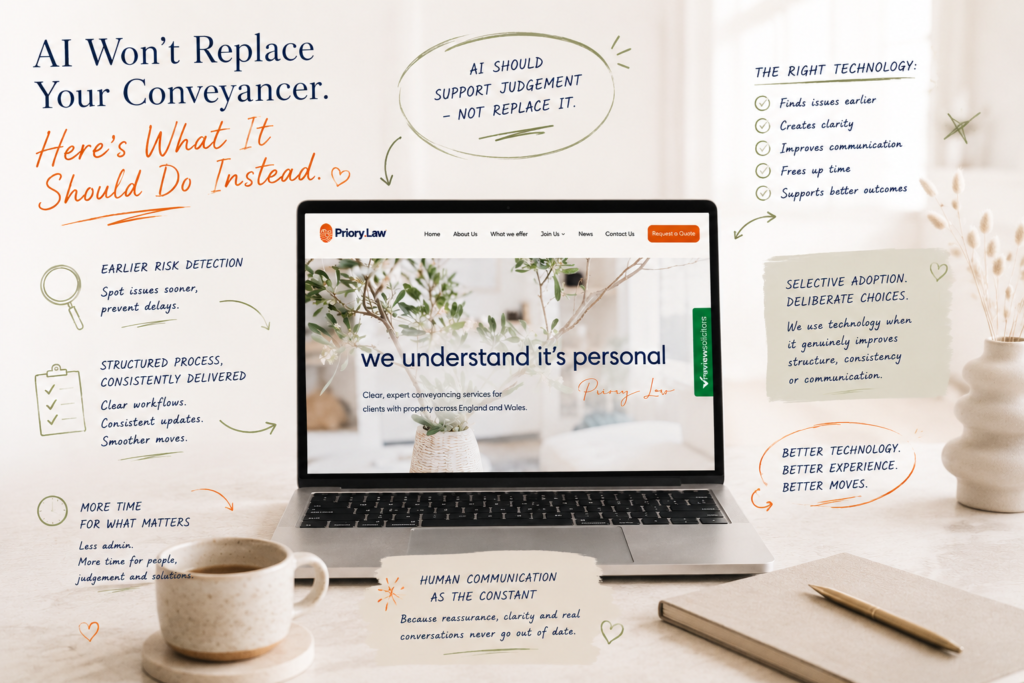
- Earlier risk identification. Tools like Orbital have fundamentally changed how we analyse title documents and raise enquiries. Issues that might previously have surfaced late in a transaction, causing delays, stress and sometimes collapse, are now visible earlier. That means they can be addressed before they become crises.
- Consistent process - consistently delivered. Our move to ProConvey was driven by structure, not features. We needed a system that supported the way we want to work: clear workflows, controlled progress, consistent communication at every stage. The client experience is shaped by what happens internally. If the process is structured, that clarity carries through.
- More time for the work that matters. When technology handles the repetitive and administrative, it frees our conveyancers to spend time on the work that requires them: their legal judgement, client communication, managing complexity.
- Human communication as the constant. At a time when people increasingly turn to AI for answers, the value of a real conversation, someone who knows your file, understands your situation and can talk you through what is happening, has never been more apparent. Automated updates have their place. They do not replace the phone call that reassures a nervous first-time buyer or keeps an estate agent informed at a critical moment.
- Selective adoption. We do not adopt technology because it is available or because competitors are using it. We adopt it when it genuinely improves structure, consistency or communication. If a system does not meet that test, it does not have a place in how we work.
What This Means If You Are Buying or Selling a Home
Most people do not ask their conveyancer about technology. They ask about cost, timescales and communication. Which is exactly right, those are the things that determine whether your move goes well.
But the technology a firm uses, and how it uses it, has a direct bearing on all three. It affects how quickly issues are identified. It affects how consistently you are kept informed. It affects whether your conveyancer has the time to focus on you.
Here are the questions worth asking:
- What systems do you use to manage my transaction, and how do they help you communicate with me?
- How do you use technology to identify risks or issues early in the process?
- Will I have a named conveyancer, or will my matter be handled by different people at different stages?
- How do you balance automated updates with direct, personal communication?
- What is your average transaction time, and what do you do to protect against delays?
At Priory Law, we welcome every one of those questions. Our answers reflect the values we were built on.
We are not always the cheapest option. But we are the firm that treats your move as the significant life event it is, with the care, the systems and the people that deserves.
A Note for Estate Agents and Mortgage Brokers
If you refer clients to conveyancers, how a firm uses technology matters to you directly.
A firm with well-structured systems will communicate with you proactively, flag issues early and keep chains moving. A firm without them, however experienced its people, will create delays that reflect on you.
When you recommend a client to Priory Law, you are referring them to a firm that will:
- Keep you updated proactively throughout the transaction
- Communicate directly with you when issues arise, before they become crises
- Handle your client’s matter with the same care you would want for your own family
If you would like to discuss a referral relationship with Priory Law, we would be glad to talk.
Looking Ahead
The role of AI in conveyancing will continue to grow. It is likely that structured, AI-supported processes will become part of how the profession demonstrates a consistent and defensible approach to risk management, and there is a credible case that this will eventually extend into what professional indemnity insurers expect to see.
The question is no longer whether firms should engage with this. It is how well they choose to do so.
The wider industry is also moving towards greater connectivity: shared data, earlier access to property information, better alignment between lenders, agents, brokers and conveyancers. These are positive developments. But they require careful implementation by professionals who understand how all the parts fit together, and what happens when they do not. Our approach will continue to reflect that: measured, selective, and always in service of the people at the centre of the transaction.
What Won’t Change
Despite the pace of change, one principle stays constant. No two transactions are the same. Every property has its own characteristics. Every client has their own priorities. Every chain introduces its own variables. Conveyancing is not a process to be managed. It is a responsibility.
We understand it’s personal.
If you’re buying, selling or remortgaging in England or Wales and want to talk to a conveyancing firm that thinks this way, we’d be glad to hear from you. Get in touch with Priory Law.
Frequently Asked Questions
Will AI replace conveyancers?
No. Conveyancing requires legal judgement, risk interpretation and professional accountability that cannot be automated. AI tools can support conveyancers by handling repetitive tasks, identifying issues earlier and improving consistency, but the responsibility for the transaction always rests with a qualified professional. The firms that use AI well are the ones where it makes their conveyancers better, not the ones where it tries to replace them.
How does technology affect my experience as a buyer or seller?
When used well, technology means issues are caught earlier, communication is more consistent and your conveyancer has more time to focus on your matter. At Priory Law, the purpose of every system we use is to create a better, calmer, more transparent experience for the people going through a transaction.
How is Priory Law different from other conveyancing firms?
Priory Law deliberately keeps caseloads lower than the industry average, uses carefully selected technology to support, not replace, its conveyancers, and prioritises proactive communication throughout every transaction. Every client has a named fee earner and receives regular updates. Priory Law acts for clients buying, selling, remortgaging and navigating all types of residential property transactions across England and Wales.
Where can I read Priory Law reviews?
Priory Law has a growing number of five-star reviews on Google and ReviewSolicitors.
About the Author - Anne-Marie Fowler
Anne-Marie Fowler is the Managing Director of Priory Law and a qualified Licensed Conveyancer with a career spanning estate agency, lettings, block management and residential conveyancing. That breadth of experience gives her an unusually complete understanding of the full transaction, and the pressures felt by every party involved in it.
Anne-Marie qualified in 2015 while working full-time and raising two children. Since then, she has built her reputation on a clear conviction: that conveyancing can, and should, be done differently. Lower caseloads. Higher supervision. Genuine transparency. And a personal approach that treats every transaction as the significant life event it is. She is an active voice in conversations around the future of conveyancing, with a particular focus on AI, risk and professional standards.
About Priory Law
Priory Law is a specialist residential conveyancing firm acting for clients across England and Wales. Regulated by the Council for Licensed Conveyancers (CLC Licence No. 12134), the firm is recognised for its structured, transparent and client-focused approach - a calm, considered alternative to high-volume conveyancing models.
Every transaction is handled by a dedicated conveyancer, supported by clear communication and a process designed to maintain consistency and control from instruction to completion.
Get in touch with Priory Law · Google Reviews · ReviewSolicitors
© Priory Law 2026. This article is for informational purposes and does not constitute legal advice. For advice specific to your property transaction, please contact Priory Law directly.