

By Anne-Marie Fowler, Managing Director, Priory Law
Something important happened in the property world last week. It didn't make the national headlines, but if you are buying or selling a home anywhere in England or Wales, it directly affects you. The Conveyancing Task Force, a group of 23 practising conveyancers including law firms, local law societies and individual professionals, sent a formal briefing to Florence Eshalomi MP, Chair of the Housing, Communities and Local Government Select Committee.
Their conclusion was unambiguous.
The homebuying process is failing people. Transactions are collapsing, delays are routine, and stress has become an accepted part of moving home. And the primary cause is not outdated processes, insufficient paperwork or a lack of digital tools. It is excessive caseloads, inadequate supervision and weak professional standards.
In their own words:
"No amount of additional process or digitalisation will compensate for weak professional standards, inadequate supervision or excessive caseloads. Conveyancing is a legal discipline requiring careful investigation, interpretation and risk assessment. It cannot safely be reduced to a largely administrative workflow."
This is something I have believed for years. It is the reason I joined Priory Law, and why I have driven the values and model that define how we work today.
Why Conveyancing Keeps Failing – The Problem Nobody Wants to Name
Every year, hundreds of thousands of property transactions in England and Wales are delayed, damaged or destroyed by poor communication and under-resourced conveyancers. The data is stark. The average property transaction now takes well over 150 days to complete. Fall-through rates, transactions that collapse after significant time and cost has been spent, remain stubbornly high. Buyers lose thousands. Sellers lose buyers. Chains collapse. Lives are put on hold.
The industry has responded, largely, by investing in technology. Case management systems. Digital ID verification. Automated updates. These are useful tools. But the Conveyancing Task Force is right: they do not fix the underlying problem. The underlying problem is this: parts of the conveyancing market have built their businesses around volume. The model is simple: take on as many cases as possible, keep fees low, use technology to manage the flow. It works commercially, at least in the short term. But it does not work for the people at the centre of every transaction.
A conveyancer carrying 100, 150 or more active cases cannot give each one the attention it needs. Communication becomes reactive rather than proactive. Supervision becomes nominal. Errors go unchecked. Clients are left chasing updates that should have been sent automatically, waiting for calls that never come, wondering whether anyone is actually looking after their move. This is not a failure of individual conveyancers. Most are skilled, dedicated professionals working under impossible pressure. It is a failure of the business models that put them there.
What the Priory Law Model Does Differently
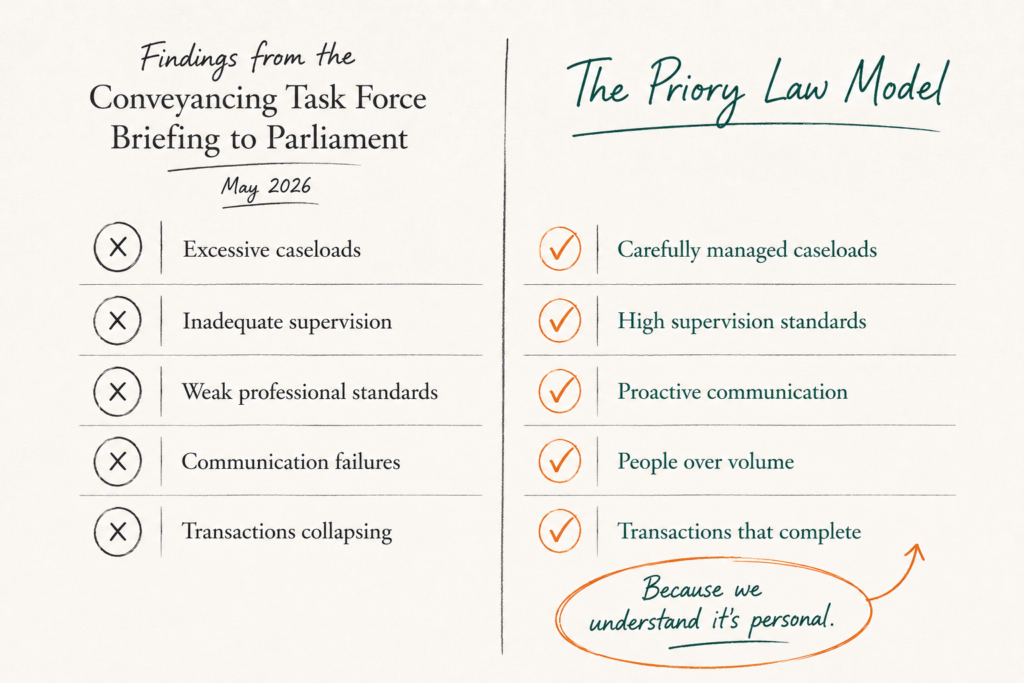
When I took on the leadership of Priory Law, I made a deliberate commitment to build on a set of values that go against the prevailing logic of the conveyancing industry. We keep caseloads carefully managed.
Our fee earners carry lower case volumes than the industry average. Not because we lack capacity, but because we understand what proper conveyancing requires. Every transaction, whether it is a first-time buyer purchase, a complex leasehold sale or a remortgage, deserves focused legal attention, timely communication and genuine human oversight.
This is what that looks like in practice:
Managed caseloads. Each fee earner at Priory Law carries a workload that allows them to know their cases, communicate proactively and respond to issues before they become problems. This is a structural choice, not a lucky circumstance.
High supervision. Legal work at Priory Law is supervised properly. Not as a compliance box-tick, but because the quality of conveyancing depends on experienced oversight at every stage. Mistakes in property law are not easily undone.
Proactive communication. We do not wait for clients to chase us. We provide regular, clear updates throughout every transaction. Clients always know where their matter stands. So do their estate agents and mortgage brokers.
People over volume. We will never prioritise the number of transactions we process over the quality of service we deliver. The two are in direct conflict, and we have chosen our side.
Technology that supports, not replaces. We embrace innovation… AI, digital tools, modern systems — because they free our team to spend more time on the work that matters most: the legal judgement, the human relationships, the careful attention that no algorithm can replace.
What This Means If You Are Buying or Selling a Home
Choosing a conveyancer can feel like an administrative decision. It is not.
The firm you instruct will have more influence over the success of your move than almost any other professional involved in the process. A proactive, well-resourced conveyancer can hold a chain together under pressure, anticipate problems before they escalate and keep everyone informed and calm. A reactive, overloaded one can do the opposite, through no fault of their own.
Here are the questions worth asking before you instruct any conveyancer:
- How many active cases does my fee earner carry at any one time?
- How will you keep me updated, and how often?
- Who supervises the legal work on my transaction?
- What is your average transaction time?
- How do you handle communication with my estate agent and mortgage broker?
At Priory Law, we welcome every single one of those questions. Our answers reflect the values we were built on.
We are not always the cheapest option, but we are the firm that treats your move as the significant life event it is, with the care, attention and expertise that deserves.
A Note for Estate Agents and Mortgage Brokers
If you work in property and refer clients to conveyancers, this matters directly to you.
A collapsed transaction does not just cost your client. It costs you - your time, your relationship and your commission. The single biggest protection against fall-throughs is not upfront information packs or digital searches. It is a well-resourced, communicative conveyancer who keeps the chain informed and moving.
When you refer a client to Priory Law, you are referring them to a firm that will:
- Keep you updated proactively throughout the transaction
- Communicate directly with you when issues arise, before they become crises
- Handle your client's matter with the same care you would want for your own family
We work with estate agents, mortgage brokers, financial advisers and other property professionals across England and Wales. We understand that our performance reflects on you, and we take that seriously.
If you would like to discuss a referral relationship with Priory Law, we would be glad to talk.
The Bigger Picture
The Conveyancing Task Force's letter to Parliament is significant not because it says something new, but because it says something true, formally, publicly and on the record.
The homebuying process in England and Wales needs reform. The government is right to push for it. But technology alone will not deliver it. Digitalisation alone will not deliver it. What will deliver it is a fundamental shift in how conveyancing firms are structured, resourced and held accountable.
Some firms are already doing this. Priory Law is one of them.
We were not built in response to a parliamentary briefing. We were built in response to a simple, human observation: that moving home should feel supported, not abandoned. That clients deserve to know what is happening with one of the biggest financial decisions of their lives. That a good conveyancer is not just a legal technician — they are the calm, informed, trustworthy professional at the centre of a process that touches everything.
We understand it's personal.
Frequently Asked Questions
What is the Conveyancing Task Force? The Conveyancing Task Force (CTF) is a group of 23 practising conveyancing professionals – including law firms, individual conveyancers and local law societies – formed to address structural problems in the homebuying process in England and Wales. In May 2026, the CTF sent a formal briefing to MPs warning that excessive caseloads, inadequate supervision and weak professional standards are the primary causes of conveyancing failures.
Why do excessive caseloads cause conveyancing delays? When a conveyancer carries too many active cases simultaneously, they cannot communicate proactively with every client, monitor every transaction closely or respond quickly to issues as they arise. Communication becomes reactive, errors go unnoticed for longer, and transactions stall. The Conveyancing Task Force identified excessive caseloads as one of the primary structural causes of delays and failed transactions in England and Wales.
What should I look for when choosing a conveyancer in England or Wales? Look for a firm that manages caseloads carefully, communicates proactively without you needing to chase, has proper supervision structures, and can demonstrate a strong track record through independent reviews. Ask specifically how many cases your fee earner carries and how often you will receive updates.
How is Priory Law different from other conveyancing firms? Priory Law deliberately keeps caseloads lower than the industry average, invests in high supervision standards and prioritises proactive communication. Every client has a named fee earner and receives regular updates throughout their transaction. Priory Law serves clients buying, selling, remortgaging and navigating all types of residential property transactions across England and Wales.
Does Priory Law work with estate agents and mortgage brokers? Yes. Priory Law works with estate agents, mortgage brokers, financial advisers and other property professionals across England and Wales. We prioritise communication with professional partners throughout every transaction and understand the importance of keeping chains informed and moving.
Where can I read Priory Law reviews? Priory Law has a growing number of five-star reviews on Google and ReviewSolicitors.
About the Author
Anne-Marie Fowler is the Managing Director of Priory Law, a specialist residential conveyancing firm providing expert property law services throughout England and Wales. Priory Law is recognised for its deep conveyancing expertise, proactive communication and exceptional client care. Since joining Priory Law, Anne-Marie has driven a clear vision: that conveyancing can, and should, be done differently, with lower caseloads, higher supervision, genuine transparency and a personal approach that treats every transaction as the significant life event it is.
Get in touch with Priory Law · Google Reviews · ReviewSolicitors
© Priory Law 2026. This article is for informational purposes and does not constitute legal advice. For advice specific to your property transaction, please contact Priory Law directly.