
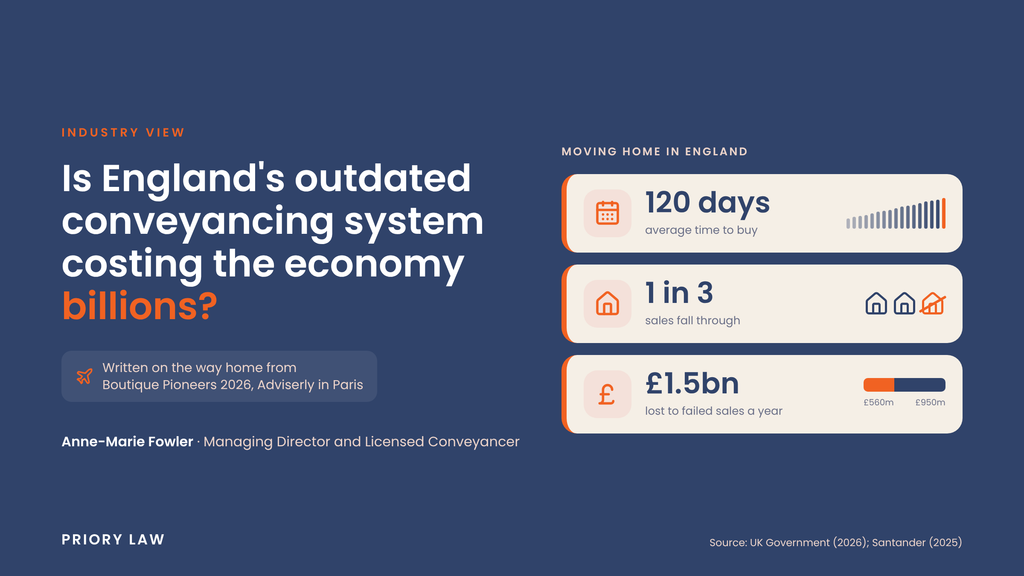
By Anne-Marie Fowler, Managing Director and Licensed Conveyancer, Priory Law
I’m writing this from the back of a cab in Paris, on my way home from Boutique Pioneers 2026, Adviserly’s conference for boutique law firms.
There is something about being away from your desk, and out of the country, that makes you look at familiar things differently. Sitting in Paris traffic, one question about conveyancing reform kept coming back to me. What if one of the simplest ways to stimulate the economy was to make it easier for people to move home? We spend enormous amounts of time discussing how to build more homes, improve affordability and drive economic growth. Yet comparatively little attention is given to how well we help people buy and sell the homes we already have.
That is an extraordinary omission.
The Government’s own figures show the scale. Around 1.2 million homes change hands across the UK each year, in a sector that employs more than a million people and contributes around £100 billion a year to the economy. Yet the process at the heart of all that activity is slow, fragmented and uncertain. The Government puts the average home purchase in England at around 120 days. Around one in three sales falls through.
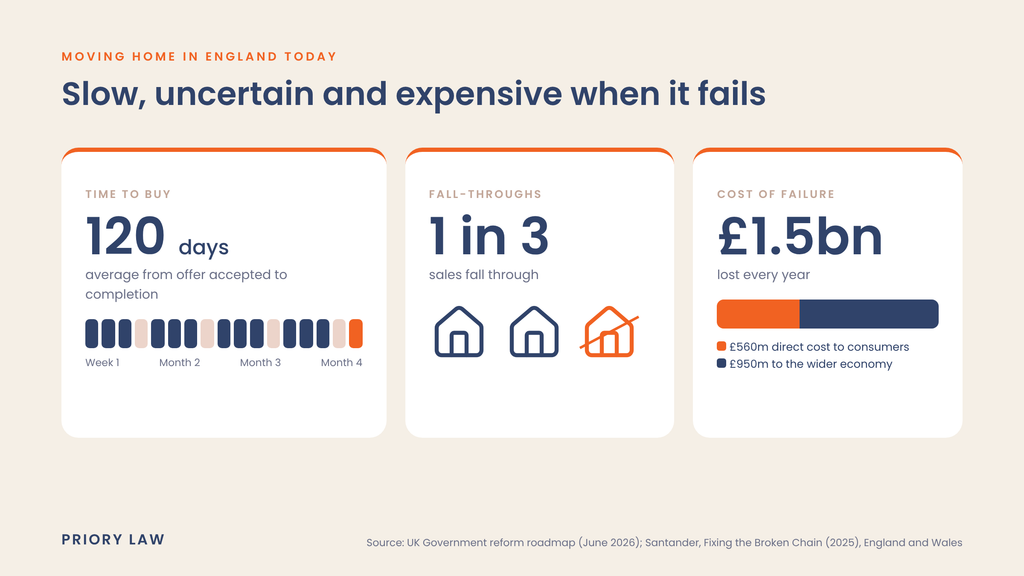
Imagine any other major sector where a customer could spend four months progressing a purchase, run up substantial costs, and then walk away with no contractual consequences.
Would we accept that as an efficient way to do business?
The opportunity hiding in plain sight
Around 4% of England’s homes change hands each year.
What if that rose to 5%?
England has around 25.6 million homes. One extra percentage point would mean roughly 256,000 more moves every year.
Research by Knight Frank and the Home Builders Federation in 2020 estimated that every resale transaction adds around £9,559 to the economy. Apply that figure, and those extra moves could be associated with around £2.45 billion of additional economic activity a year.
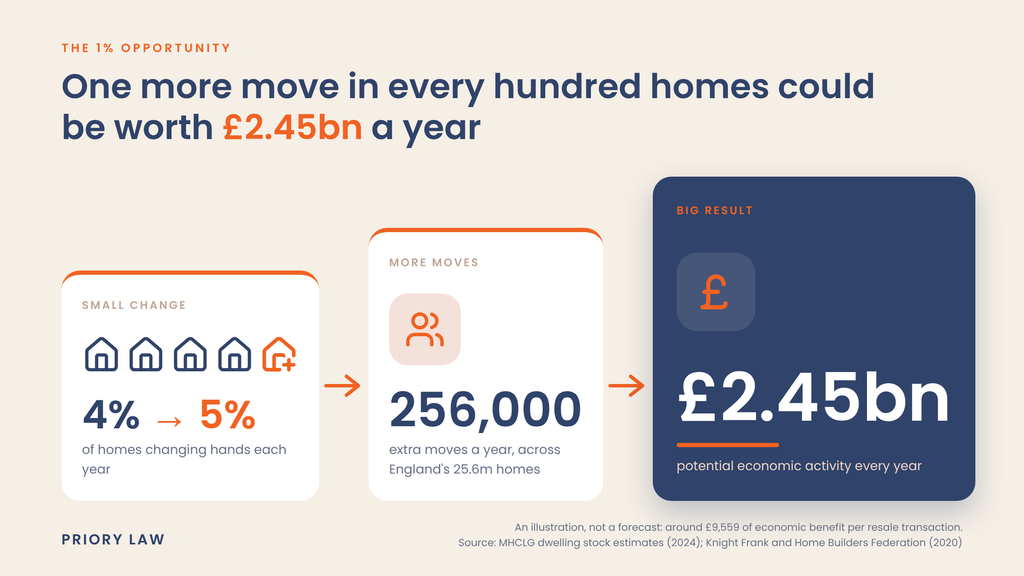
That is an illustration, not a forecast. Reforming conveyancing alone would not deliver that increase, and not every move generates the same value. But the potential scale deserves serious attention.
A house move is rarely an isolated financial event. It creates work for estate agents, surveyors, conveyancers, mortgage advisers, removals companies, tradespeople, furniture retailers and many other businesses. It may also free up a family home, allow an older homeowner to downsize, or let someone relocate for a better job.
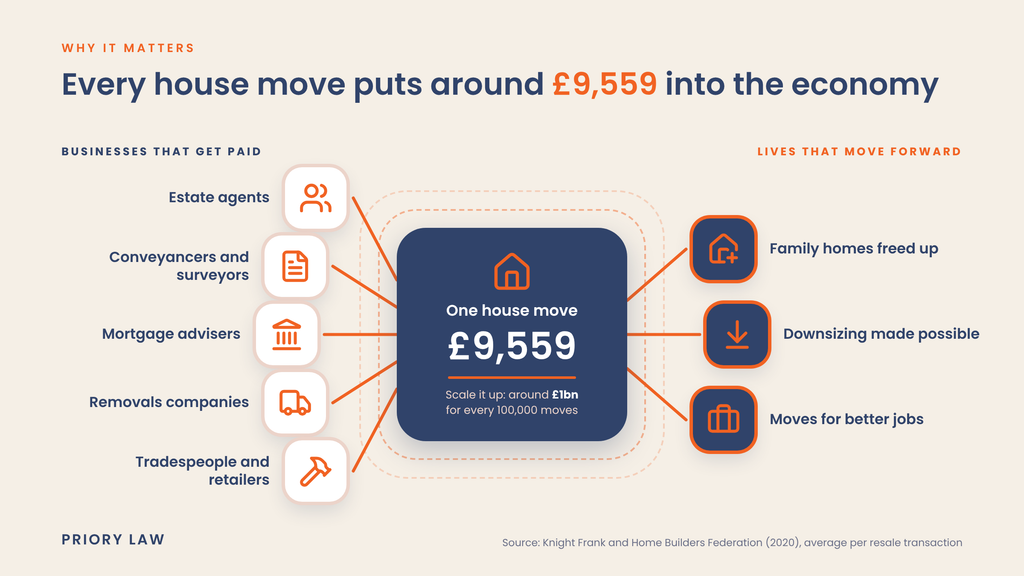
When we make it harder to move, we hold back far more than the housing market.
What can we learn from elsewhere?
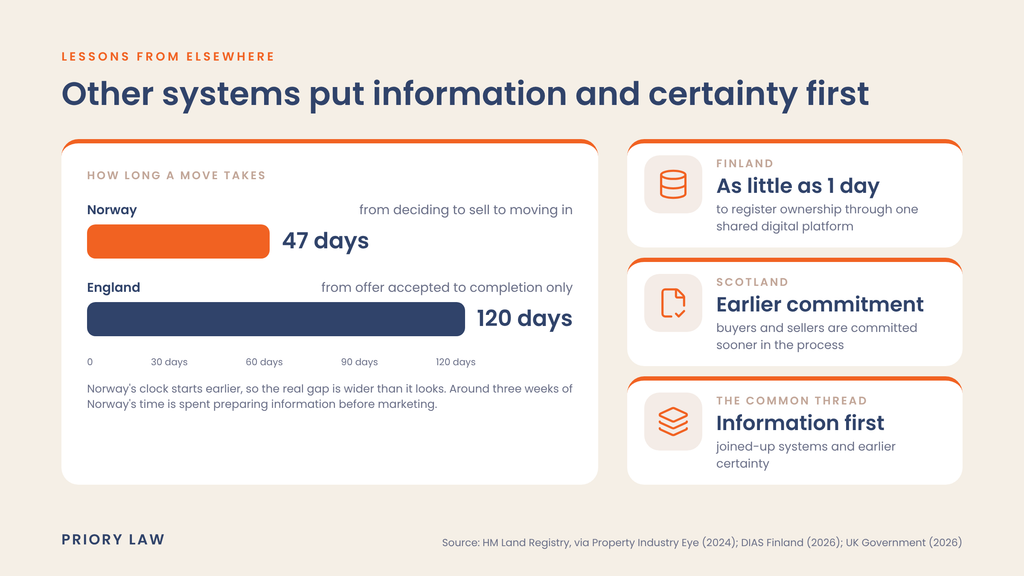
Other countries show that buying a home does not have to take this long, or carry this much uncertainty. In Norway, HM Land Registry has pointed to an average of 47 days from the moment someone decides to sell to the day the buyer moves in. Around three weeks of that is spent gathering the property information before the home even goes on the market. The information comes first, so the transaction itself moves quickly. In Finland, a shared digital platform called DIAS connects banks, estate agents, buyers and sellers in one process. Ownership can be registered in as little as a day, and by mid-2026 around two in three agent-led sales of flats were completed this way.
Closer to home, Scotland shows the value of earlier contractual commitment.
Of course, these systems are not identical to ours. Norway’s market is a fraction of the size of ours, and property law, tax, lending and housing markets all differ. We should be wary of copying any of them wholesale.
But the lessons are clear enough. The information comes first. The systems talk to each other. Commitment comes earlier. None of that is out of reach. So the question is why we continue to tolerate avoidable delays, duplicated work and uncertainty when others have shown there is another way.
The price of uncertainty
Santander’s 2025 research, Fixing the Broken Chain, estimated that failed transactions cost consumers and the economy in England and Wales at least £1.5 billion a year. More than a quarter of people surveyed said the experience made them less likely to move again.
But even that does not capture the full cost of a difficult property market.
- How many older homeowners decide against downsizing because the process feels overwhelming?
- How many growing families put off moving because they fear the uncertainty of a chain?
- How many people turn down opportunities elsewhere because relocating is too difficult?
- And how many potential sellers never enter the market at all?
These costs are harder to quantify. That is exactly why we should be measuring them.
Reform should be an economic priority
As a Licensed Conveyancer, I understand why due diligence matters. Lenders need protecting. Buyers need to understand what they are buying.
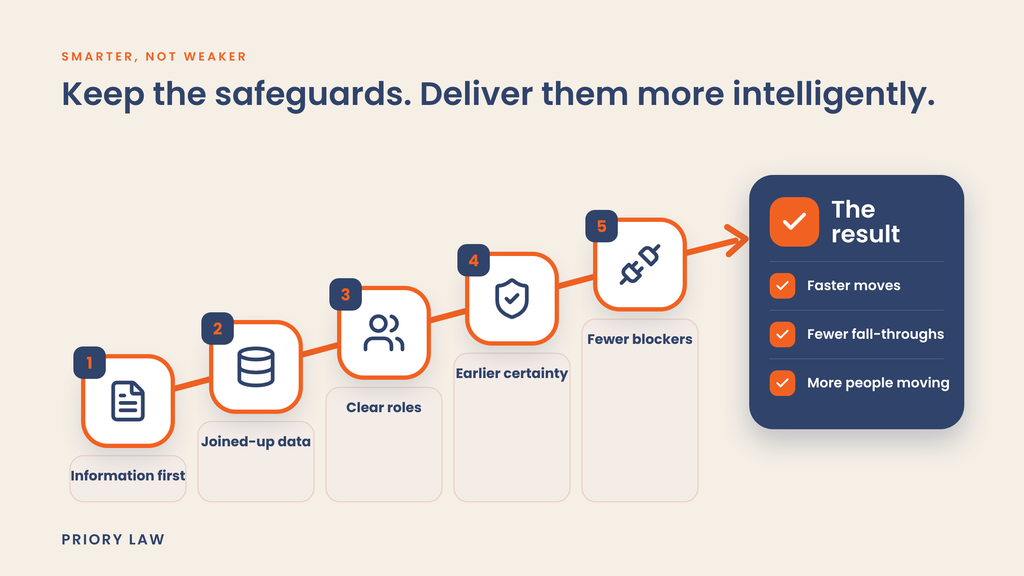
The answer is not to abandon those safeguards. It is to deliver them more intelligently.
- Property information should be available earlier, ideally before a home goes on the market.
- Digital records should be accessible and joined up, so the same data is not requested again and again.
- Everyone’s responsibilities should be clearer, from agents and lenders to conveyancers and managing agents.
- We should explore earlier contractual certainty, while keeping the right consumer protections in place.
- We must tackle the structural blockers, including fragmented leasehold information.
This is the thinking behind Head Start at Priory Law: helping sellers get their legal preparation underway before a buyer is found, so the information is ready when the offer arrives. Everyone in the chain benefits when the work starts earlier.
The Government’s home buying and selling reform roadmap, published in June 2026, recognises many of these issues, from upfront property information and binding contracts to digital identity checks and electronic signatures. That is welcome. But much of it will not become law until the end of this Parliament, and some only when parliamentary time allows. We should also be more ambitious about how we measure success. Reducing transaction times is important. Reducing fall-throughs is essential.
Increasing the number of households able and willing to move should also be an explicit economic objective.
A bigger ambition for our housing market
We need to stop thinking about conveyancing reform only as a way to make transactions less frustrating. It is an opportunity to improve housing mobility, unlock economic activity and help people move into homes that better suit their lives. We should set measurable national goals for transaction speed, certainty and housing turnover, supported by honest international comparisons. Then we should measure the wider economic benefits of reaching them.
We do not need to copy another country’s property system wholesale. But we do need to ask why a process so central to household finances and economic activity remains so difficult. Every transaction that collapses unnecessarily is more than a disappointed buyer or seller. And every household put off moving may be an economic opportunity that never happens.
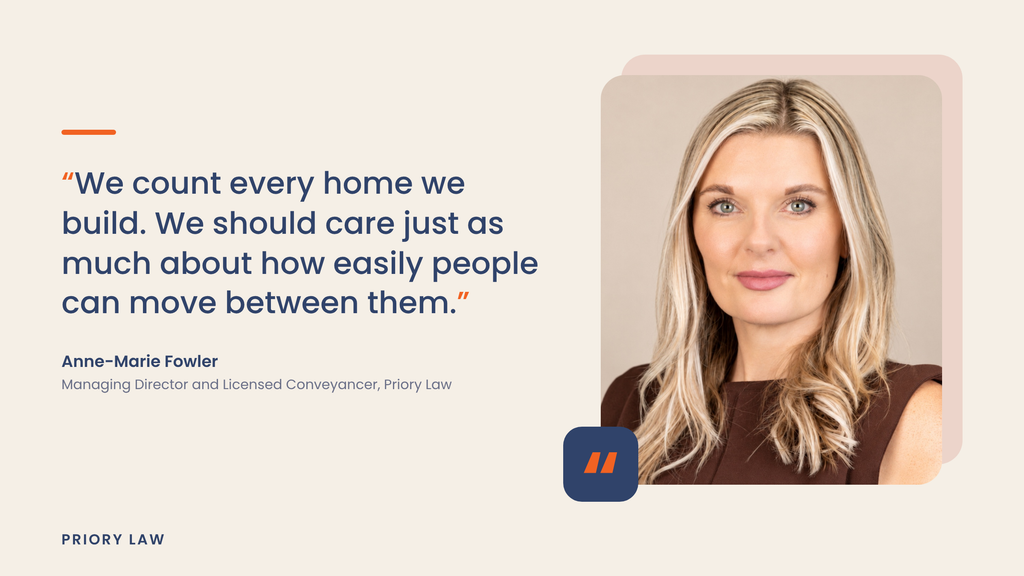
We count every home we build. We should care just as much about how easily people can move between them.
We understand it’s personal.
If you’re an estate agent, broker or property professional and want to talk about getting sellers ready earlier, we’d love to hear from you. Get in touch with Priory Law.
Frequently asked questions
How long does it take to buy a house in England?
The Government puts the average home purchase at around 120 days. Timescales vary with the property, the chain and how quickly information is available. Starting the legal preparation early is one of the most effective ways to avoid delays.
How many property sales fall through?
Around one in three sales falls through, according to Government figures. Santander’s 2025 research estimated that failed transactions cost consumers and the economy in England and Wales at least £1.5 billion a year.
What are the Government’s home buying and selling reforms?
In June 2026 the Government published a reform roadmap for home buying and selling in England. It includes upfront property information, digital identity checks, electronic signatures and support for AI-assisted conveyancing, with the aim of making moving faster, cheaper and less stressful.
How do other countries buy and sell homes faster?
In Norway, much of the property information is gathered before a home is marketed. Finland uses a shared digital platform, DIAS, that connects banks, agents and buyers. Scotland has earlier contractual commitment. Each system is different, but all of them put information and certainty earlier in the process.
How can sellers avoid delays when selling?
Instruct a conveyancer as soon as you decide to sell, not once you have a buyer. Getting title documents, property information and any leasehold details ready early means the transaction can move as soon as an offer is accepted.
What is a Licensed Conveyancer?
A Licensed Conveyancer is a specialist property lawyer regulated by the Council for Licensed Conveyancers (CLC). Licensed Conveyancers focus entirely on property law, and many specialise in residential conveyancing.
About the author: Anne-Marie Fowler
Anne-Marie Fowler is the Managing Director of Priory Law and a qualified Licensed Conveyancer. Her career spans estate agency, lettings, block management and residential conveyancing, a breadth that gives her a fuller picture of the property transaction than most conveyancers carry.
She qualified in 2015 while working full-time and raising two children. Since then she has built Priory Law around a clear conviction: that conveyancing should be done differently. Managed caseloads. Proper supervision. Genuine transparency. A personal approach that takes seriously what moving home actually means to people.
Anne-Marie is a regular voice in industry conversations about reform, risk and professional standards in conveyancing.
About Priory Law
Priory Law is a specialist residential conveyancing firm acting for clients across England and Wales. Regulated by the Council for Licensed Conveyancers (CLC Licence No. 12134), the firm offers a structured, transparent and personal alternative to high-volume conveyancing.
Every transaction is handled by a dedicated conveyancer, with clear communication and a process designed to stay in control from instruction to completion.
Get in touch with Priory Law · Google Reviews · ReviewSolicitors
Sources
- GOV.UK: Home buying and selling reform roadmap (June 2026)
- GOV.UK: Dwelling stock estimates, England, 31 March 2024
- Knight Frank and HBF: Economic benefits of housing market activity (2020)
- Santander: Fixing the Broken Chain (2025)
- Property Industry Eye: HM Land Registry on Norway’s 47-day process
- DIAS: Finland’s digital housing transactions
- Alma Media: DIAS share of transactions, June 2026
© Priory Law 2026. This article is for informational purposes and does not constitute legal advice. For advice specific to your property